
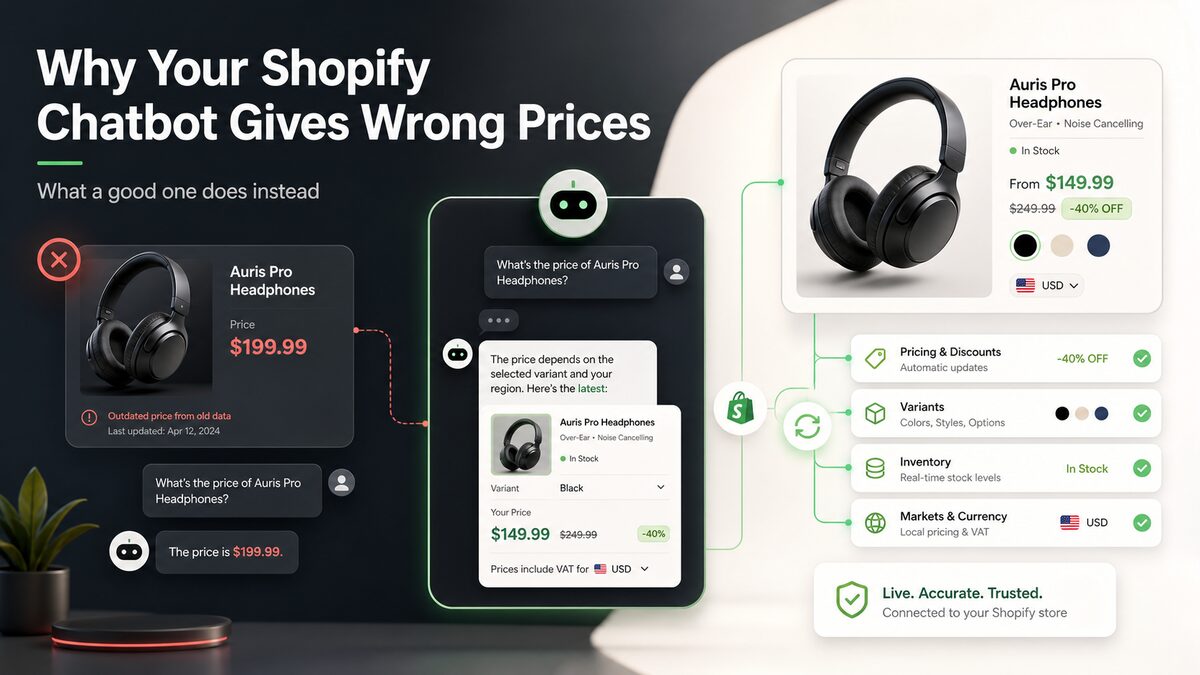
A shopper opens your store at 11pm. They like a jacket, and they ask the chat widget two things: "Is the medium in stock, and how much is it right now?"
The chatbot answers instantly and confidently: "Yes, the medium is in stock — £49."
Except the medium sold out this afternoon, and the price went up to £59 when your sale ended at midnight. The bot wasn't lying. It was answering from a copy of your store it memorised three weeks ago. The customer either buys on wrong information and contacts you angry later, or — more often — quietly distrusts the whole site and leaves.
This is the single most common failure mode for chatbots on e-commerce stores, and almost nobody selling you one will mention it. It's worth understanding why it happens, because the fix is a real difference between tools, not a marketing line.
Why "Trained on Your Store" Quietly Goes Wrong
Most AI chatbots work by learning your content once. They read your pages, convert them into a form the model can search, and from then on they answer from that snapshot. For a lot of content, that's exactly right. Your shipping policy doesn't change on a Tuesday afternoon. Your returns window, your sizing guide, your brand story — these are stable, and a bot that learned them last month is still correct today.
The problem is that an e-commerce store isn't made of stable facts. It's made of two very different kinds of information mixed together on the same product page:
- Things that change slowly or never — the product description, what it's made of, how it fits, your delivery options.
- Things that change constantly — the live price, whether a size is in stock, today's discount, the status of someone's order.
When a chatbot memorises a product page, it memorises both at once. The description ages gracefully. The price and stock level are wrong almost immediately — and there's no honest way to fix that by "training more often." A flash sale can change every price in your store in a minute. Inventory moves with every checkout. You cannot re-memorise a catalog fast enough to keep up, and even if you tried, the bot would still be answering from a snapshot that's minutes or hours stale.
So the real question to ask any chatbot for your store isn't "is it trained on my products?" It's "what does it do at the exact moment a customer asks about price or stock?"
The Principle: Split Your Data by How Fast It Changes
A chatbot built properly for e-commerce treats those two kinds of information completely differently.
Slow-changing content is learned. Product descriptions, materials, fit notes, collections, shipping and returns policies, your FAQ — this is exactly the content that benefits from being learned and searched semantically. When a customer asks "do you have anything waterproof for hiking?", the bot should understand the question and surface the right products from what it knows. That's the part that works well as memorised knowledge, and it stays accurate because the underlying facts don't move.
Fast-changing facts are looked up live. Price, stock level, variant availability, current promotions, order status — these should never be answered from memory. When a customer asks "is the medium in stock right now?", a good chatbot doesn't recall an answer. It checks your store, in that second, and answers from what's actually true at that moment. If the size sold out an hour ago, the bot says so.
The difference sounds subtle written down. In practice it's the difference between a tool that builds trust and one that slowly erodes it. A bot that says "the medium's gone, but the large is in stock and on the same sale until midnight" is doing the job of a good shop assistant. A bot that confidently quotes a price from three weeks ago is a liability wearing a friendly interface.
What to Get Right Before You Connect Your Store
If you're setting this up — or auditing a chatbot you already run — a short review beforehand saves a lot of confused answers later.
Make sure your descriptions actually describe. The learned half of the bot is only as good as your product copy. If half your listings have a one-line description copied from the supplier, the bot has little to work with. The products with rich, specific descriptions are the ones it will recommend well.
Tidy your collections and tags. A bot that understands your store leans on its structure. Clean collections ("waterproof", "under £50", "gifts for new parents") give it the handles it needs to answer browsing-style questions, not just exact-product ones.
Write your policies in plain language. Returns, shipping times, international delivery, exchanges — these are the most-asked pre-purchase questions, and they're learned content, so the bot will answer them straight from your pages. If they're buried in legal phrasing or contradict each other across pages, the bot's answers will be just as confusing. Fix the source first.
Decide what it should never do. A store chatbot should answer questions and guide people to checkout. It shouldn't be applying discounts it invented, promising delivery dates you didn't set, or guessing about a product it has no information on. The right behaviour for an unknown is to say so and offer a human — not to improvise.
Where It Should Hand Off
Some questions need a person, and a good bot knows the edge of its own competence. A complicated international order, a complaint, a question about a product detail that simply isn't documented anywhere — these aren't failures, they're handoffs.
The behaviour that matters here is honesty. "I don't have that detail, but here's how to reach the team" is a far better outcome than a confident guess about your return policy or a made-up delivery estimate. On a store, a wrong answer doesn't just disappoint — it can cost you a sale, a chargeback, or a review. A clean handoff costs you nothing.
The Real Test
When you're evaluating any AI chatbot for your Shopify store, skip the demo of it answering a question about your brand story. That's the easy half. Ask it something that changes: a price, a stock level, an order. Then change that thing in your store and ask again.
If the answer updates, the tool understands the difference between what to learn and what to look up. If it confidently repeats the old answer, it memorised your store — and it will be wrong about the things that cost you customers, every single day, without ever telling you.
See how CYBOT connects to your Shopify store and answers from live product data →