
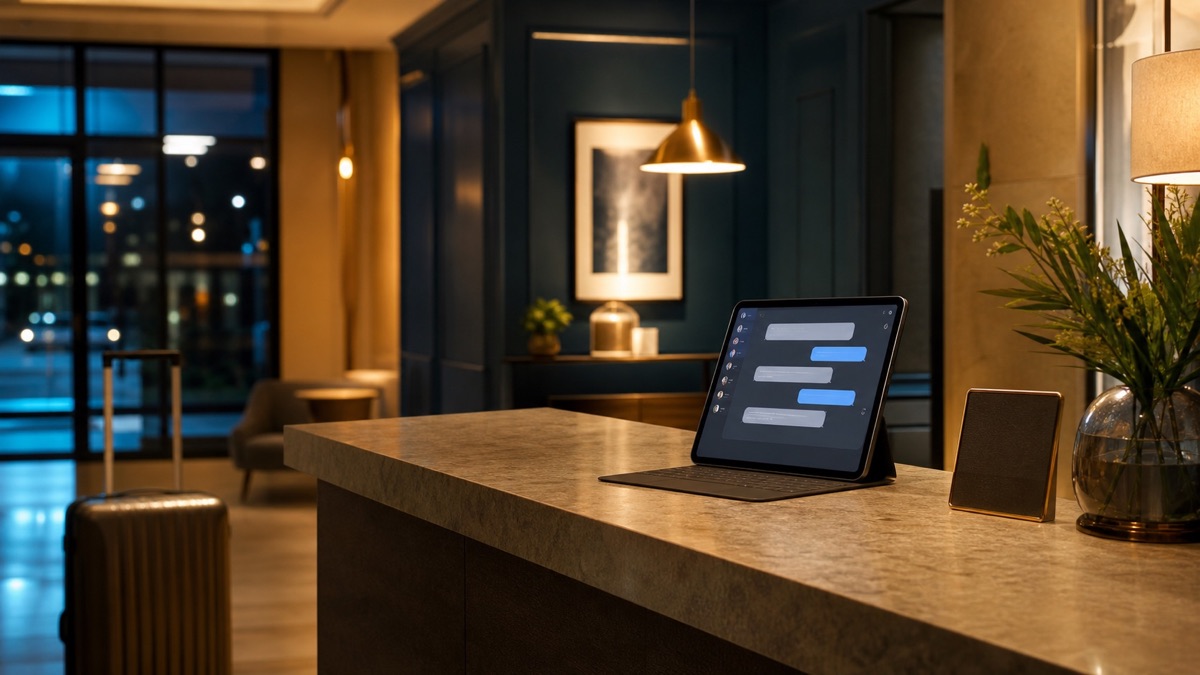
Two hotels. Same price. Same location on the map. Same star rating. One answers availability questions instantly at midnight. The other responds by email the next morning.
The booking goes to the first one.
This isn't a hypothesis. It's the decision pattern of a traveller who has already decided they want to stay somewhere in your area and is now choosing between options. Speed isn't a differentiator at the brand level — at the individual property level, it's often the deciding factor.
The Window Between Interest and Decision in Hospitality
Hospitality decisions compress quickly. A couple planning a weekend away typically compares three or four options, asks a question or two about each, and commits within the same browsing session. The property that answers within that session gets the booking. The one that replies the next day is often responding to someone who has already booked elsewhere.
This window is shorter than most property owners assume. It's not days — it's often minutes.
The questions that fall in this window are almost always answerable in advance: availability, parking, pet policy, early check-in, group rates, what's included in the rate, distance from the train station. A visitor shouldn't need to wait for a human to find out whether you have parking.
The Questions Guests Ask Before They Book
Look at any hospitality enquiry inbox and the same questions appear over and over. Not because guests lack imagination — because these are the practical details that determine whether the booking makes sense.
- Is there parking on-site, and is it free?
- Do you allow pets?
- Can we check in before 3pm?
- Is breakfast included or available?
- What's the cancellation policy?
- Are there rooms that connect for families?
- What's the nearest station / airport / town centre?
- Do you have accessibility features?
Every one of these is answerable. None requires a human to look anything up. A well-trained chatbot handles all of them at any hour, on any day, in the time it takes a guest to type the question.
What European Hospitality Businesses Are Doing Now
Across the UK, the Netherlands, France, and Spain, independent hotels and short-let operators are using AI chatbots to cover the response gap that has always existed outside business hours.
For a B&B in the Cotswolds run by two people, a chatbot answering late-evening enquiries isn't a luxury — it's the only way to compete with larger properties that have dedicated reservations staff. For a city hotel in Amsterdam with a multilingual guest base, it's a way to answer in the guest's preferred language without building a multilingual front-desk team.
The common thread: small and mid-size properties competing for the same guests as larger ones, where the service gap can be closed with the right tools.
What to Get Right Before You Start
A chatbot is only as good as the information behind it. Before setting one up, work through these questions about your own website and content.
Is your availability and rate information current? If your pricing has changed or your booking process has updated, that needs to be reflected in the content you train on.
Is your policy content clearly written? Cancellation policies, pet policies, accessibility information — if these are buried in a terms page or written in legal language, the chatbot will serve confusing answers. Plain language is better for visitors and better for the bot.
Do you have clear answers to your ten most common pre-booking questions? Write these down before setup. These are the first things to train on and the first things to test after launch.
Is your website content consistent? Contradictions between pages — a different cancellation period on the booking page versus the FAQ — will produce inconsistent bot answers. Resolve them in the source before you train.
It also helps to decide which questions belong on a reference page and which need follow-up. See where static FAQ pages fall short for visitors making a decision.
One hour of content review before setup saves you a month of fixing confusing answers after.
What Happens to the Questions the Bot Can't Handle
Some questions require a human. A group booking with unusual requirements, a complaint, a question about a specific room that isn't documented anywhere. The chatbot's job in these cases isn't to guess — it's to hand off cleanly and quickly.
A well-configured fallback says clearly: I don't have that information, here's how to reach someone who does. That's a better outcome than a confident wrong answer and far better than silence.
The goal isn't to replace human hospitality. It's to make sure that when a human is needed, the guest gets to one without friction — and that in the meantime, the questions that don't need a human aren't waiting in an inbox.
The Compounding Effect of Being Consistently Available
One booking won from a late-night enquiry is a good outcome. But the real advantage builds over time.
A property that answers reliably at midnight on a Friday accumulates a reputation — through reviews, through word of mouth, through the simple fact that guests remember having a smooth experience before they even arrived. The interaction that happened before check-in shapes how the guest feels about the property from the moment they walk through the door.
The opposite compounds too. A property that consistently fails to answer pre-booking questions trains its potential guests to go elsewhere. Not dramatically — just quietly, over hundreds of browsing sessions where someone asked a question and didn't get an answer.
Independent properties often assume they can't compete with larger chains on service infrastructure. That assumption is less true than it was. The gap between a boutique hotel in Bordeaux and a major chain in terms of responsiveness is now a configuration decision, not a staffing one.
The properties that will win the next booking cycle won't necessarily be the nicest or the cheapest. They'll be the ones that answered the question.