
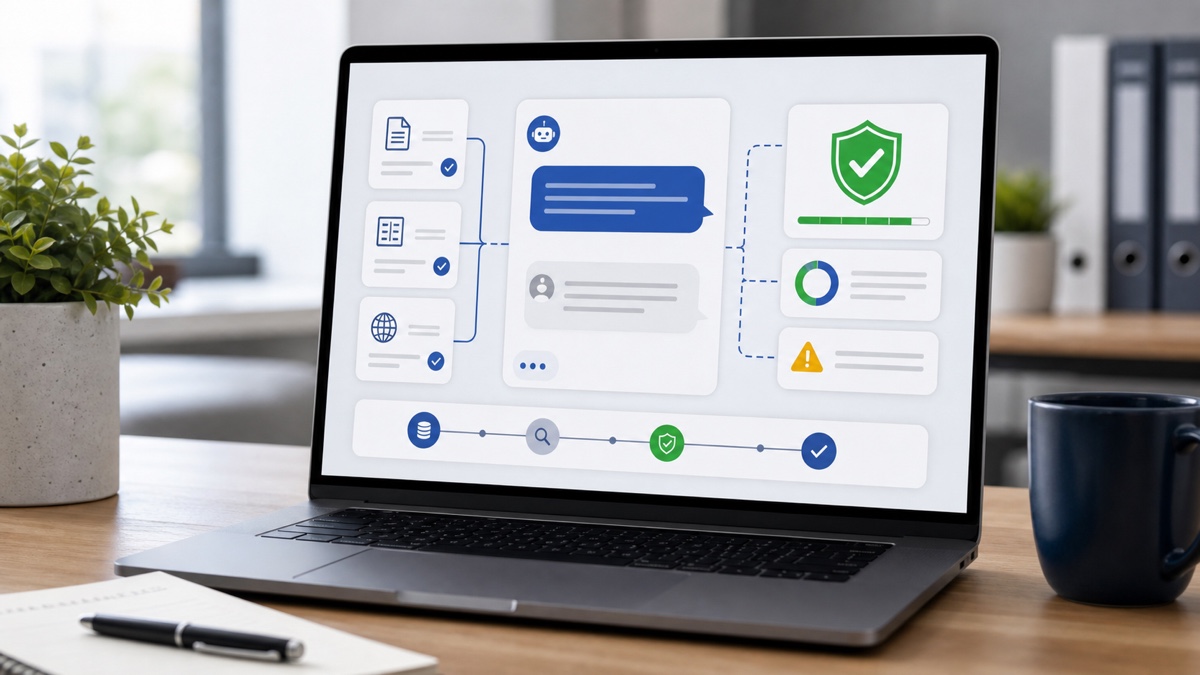
Most chatbot platforms are silent about quality. You deploy, you hope. When something goes wrong — a wrong answer, a confused visitor, a complaint — you find out from a customer, not from the system.
For many businesses, this is how it stays. A chatbot runs on their website for months, quietly giving answers that are plausible but wrong, and the first sign of a problem is a client email that says "your website told me X but that's not what happened."
A chatbot that represents your business should be able to tell you when it's uncertain. Most can't.
What Can Go Wrong in a Response
Before looking at how quality control works, it helps to be specific about what it's trying to catch.
Factual errors from outdated content. The bot was trained on your website at a point in time. Since then, a price changed, a service was retired, or a policy was updated. The bot doesn't know. It's still answering from the old version — confidently.
Out-of-scope guesses. A visitor asks something the bot was never trained to handle. A well-built system says it doesn't know and offers a path to a human. A poorly built one infers an answer. The inference may be plausible. It may also be completely wrong.
Low-confidence answers served as facts. Language models generate every response with an associated confidence level. Most platforms don't act on that signal — they serve the answer regardless of how uncertain the model was. A guess looks identical to a verified fact.
Tone mismatches. An answer that's technically correct but phrased badly — too long, too formal, too vague — still fails the visitor even when the information is right.
Inconsistency across sessions. The same question asked on different days gets meaningfully different answers. This signals unstable training content or a model that's inferring rather than retrieving from solid source material.
None of these produce an error message. There's no warning. The wrong answer just goes out.
What Automatic Validation Should Catch
A chatbot with quality controls built in handles this differently.
Confidence scoring against source content. Every answer should be assessed against the training material it was drawn from. If the answer maps closely to something in the source content, confidence is high. If the model is inferring — filling in a gap the training didn't cover — that should be flagged, not served silently.
Fallback routing for out-of-scope questions. When a question falls outside what the bot has been trained on, the right behaviour is a clean handoff — not a guess. "I don't have that information, but you can reach our team here" is a better outcome than a confident wrong answer.
Source grounding checks. A response that can't be traced back to something in the training material should be treated as a risk. Good platforms attribute responses to their source. If a claim has no source, it shouldn't be presented as fact.
Consistency monitoring over time. Responses to similar questions should be compared across sessions. Significant variation on questions that should have stable answers is a quality signal worth surfacing to the business owner — not burying in a log file.
What Visibility Should Look Like
Quality control without visibility doesn't help you improve anything.
A well-designed chatbot dashboard should show you more than a green dot that says "running." It should show which questions are being answered with high confidence, which are flagging as uncertain, and where the bot is declining to answer and routing to a human.
This turns quality control from a background process into something actionable. Instead of finding out three weeks later that visitors were getting a wrong price, you see a pattern of low-confidence responses on pricing questions — and you know to update the source content before it becomes a customer complaint.
A gap in your training content shows up as a recurring flag in the quality layer. Not as a customer who didn't come back.
What Good Looks Like Over Time
A chatbot that was set up correctly on day one should be better after six months of real conversations — because the gaps it exposed have been filled.
Every question a visitor asks that the bot can't answer well is information about what your training content is missing. A platform that surfaces this systematically makes it easy to act on. One that buries it in logs leaves the business owner guessing.
The standard to hold any chatbot platform to is simple: can I tell, at any given time, whether my chatbot is giving accurate answers? If the answer is "I'd have to check the transcripts manually", the quality control isn't good enough.
Automatic validation, confidence scoring, fallback routing, and dashboard visibility aren't advanced features. For a tool that represents your business to every visitor, they're the baseline.
Answer validation is only one part of the decision. A broader five-point framework for evaluating an AI chatbot also covers understanding, business context, follow-up questions, human handoffs, and data handling.
A Practical Checklist Before You Deploy
If you're evaluating a chatbot platform — or auditing the one you already have — these are the quality-related questions worth asking before anything else.
- Does the platform surface confidence levels per response, or does every answer look equally certain?
- What happens when a visitor asks something outside the training scope — does it fall back cleanly or does it guess?
- Can you see a log of conversations and filter by quality flags, not just by date?
- Is there any mechanism that alerts you to degrading answer quality before customers notice?
- How does the platform handle content updates — do you retrain manually, or does it pick up changes automatically?
Most vendors won't volunteer this information. Ask for it directly, and pay attention to how specific the answers are. Vague reassurances about "accuracy" and "reliability" aren't the same as a clear description of how the system handles uncertainty.
See how a CYBOT AI chatbot trained on your content keeps answers grounded, flags uncertainty, and routes cleanly to a human when it should.