
A patient visits a clinic website at 10pm. They want to know whether the clinic accepts their insurance provider. There is no one to answer. The contact form says responses take two to three working days. They try another clinic.
The first clinic does not know this happened. There is no missed call, no unanswered email. The opportunity just evaporated.
This is the default state for many European healthcare websites, and it is becoming a competitive disadvantage as patient expectations shift.
What Clinics Are Using Chatbots For Today
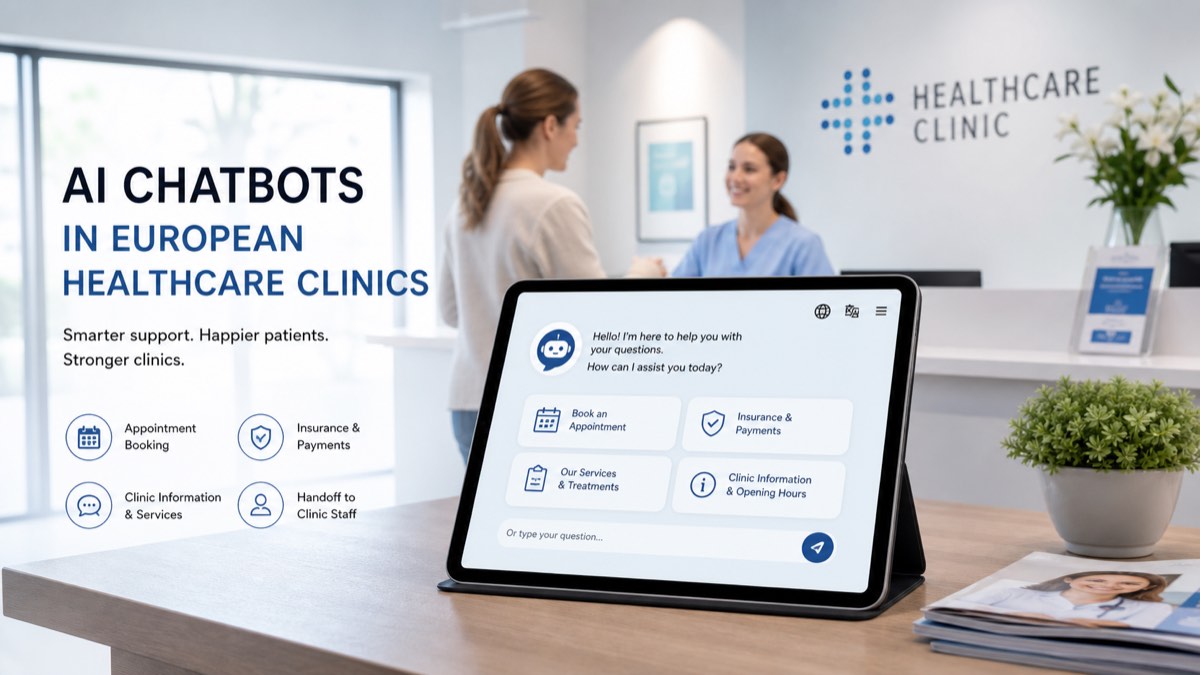
The use cases that work in healthcare are well-defined and largely administrative. Clinics across the UK, Netherlands, Germany, and Spain are using AI chatbots to handle:
Insurance and payment questions. Which providers do you work with? Do you offer payment plans? What is the cost for an initial consultation? These questions are answerable, repetitive, and time-sensitive for the patient asking them.
Service and procedure explanations. What does this treatment involve? How long does recovery take? What should I bring to my first appointment? Patients research before they commit, often outside office hours.
Signposting to the right department or specialist. Larger clinics and multi-specialty practices use chatbots to route patients correctly before they book. That reduces the admin burden of redirected appointments.
Out-of-hours availability. A significant share of healthcare decisions happen outside 9 to 5. A chatbot that answers basic questions at midnight does not replace a receptionist. It handles the volume that would otherwise go unanswered.
Multilingual patient support. In markets like the Netherlands, Switzerland, and Spain, patients may prefer to communicate in a language other than the country's administrative default. A chatbot can handle multiple languages simultaneously in a way that a small front-desk team cannot.
What Works and What Does Not
The clinics that succeed with chatbots are the ones with clear scope. The bot answers administrative and informational questions. It does not perform clinical functions.
This distinction matters more in healthcare than in most other sectors. A chatbot that attempts triage, offers a diagnosis, or gives dosage guidance is not a convenience tool. It is a liability. The line needs to be clear in configuration, not just intent.
What works well: anything that a receptionist could answer without clinical training. Opening hours, directions, service descriptions, booking process guidance, insurance queries, and document requirements for appointments.
What does not work and should not be attempted: symptom assessment, treatment recommendations, medication guidance, or anything that requires clinical judgment. If a patient asks a clinical question, the correct response is to direct them to a qualified practitioner every time.
The most effective setups make this handoff explicit. When the chatbot reaches its limit, it says so clearly and provides a direct path to a human.
What European Clinics Get Wrong When They Start
Training on internal language rather than patient language. Clinical terminology, department codes, and internal procedure names are not how patients usually search. If the chatbot is trained on internal documents without translation into plain language, it will fail to recognise what patients are actually asking.
Ignoring multilingual requirements. A clinic in Barcelona with German and British expat patients needs to account for language before launch, not after. Multilingual support is not a later addition. It shapes how you structure your training content from the start.
Overlooking GDPR compliance for conversation data. Patient conversations with chatbots may involve personal data. Under GDPR and national health data regulations, there are specific requirements around consent, storage, and data processing. Any chatbot platform used in a European healthcare context needs to be assessed against these requirements before go-live.
Going live with outdated content. Clinics that launch a chatbot without first auditing their website content end up with a bot that confidently states old prices, discontinued services, or staff members who no longer work there. The content review is not optional.
What Patients Actually Expect
There is a common assumption that patients want chatbots to feel warm and human. The evidence suggests otherwise.
Patients interacting with a clinic chatbot are usually trying to get a specific answer quickly. They want accuracy over personality. They want speed over small talk. They want to know, clearly, whether the bot can help them. If it cannot, they want to reach a human without friction.
A chatbot that hedges, asks too many clarifying questions, or gives long responses to simple queries fails on the terms that actually matter to patients. Keep answers direct. Keep scope clear. Make the handoff to a human easy to find.
Choosing the Right Platform for a Healthcare Setting
Not every chatbot platform is suitable for a clinic environment. A few things matter more in healthcare than in general business use.
Where is patient data stored? Conversations with a clinic chatbot can include personal information: names, appointment details, and health-related questions. That data should be processed and stored within the EU, under European data protection law. Ask the vendor explicitly before you sign up.
Can you define hard limits on what the bot answers? A platform that gives you clear control over scope is essential. You should be able to decide what topics are in bounds and which always route to a human through configuration, not just hope the AI stays within its lane.
Does it handle consent before the conversation starts? Under GDPR, collecting personal data through a chat interaction requires informed consent. The platform should support this natively, not leave it to you to build a workaround.
Does it work in the languages your patients use? For most European clinics, English-only is not enough. A platform with genuine multilingual support, not just page translation, handles patients in their preferred language from the first message.
Can you see what is being said? Conversation logs matter for compliance, for quality control, and for spotting where the bot is struggling. If a platform does not give you visibility into transcripts, that is a problem.
The right tool gives clinical staff back the time they were spending on administrative questions. That is the outcome worth measuring. Not the chatbot itself, but the hours it frees up for the work that actually requires a person.
See how a CYBOT AI chatbot for healthcare websites can handle clinic website enquiries while keeping scope, consent, and handoff clear.