
You are in a paid client session. It is 2 p.m. on a Wednesday. Somewhere else, a new prospect has landed on your website, read through your services page, and has a question. They want to know whether you have worked in their sector before. They want to know what a typical engagement looks like. They are interested, ready to evaluate their options, and waiting.
You are not available. Not because you do not want the lead, but because answering means interrupting the session you are currently being paid for—or letting the new enquiry go cold while you finish. Either way, you lose something. This is the structural problem that most consulting websites have never solved.
It is not simply a marketing problem. It is a timing problem. And it affects independent consultants and consulting firms equally, just at different scales.
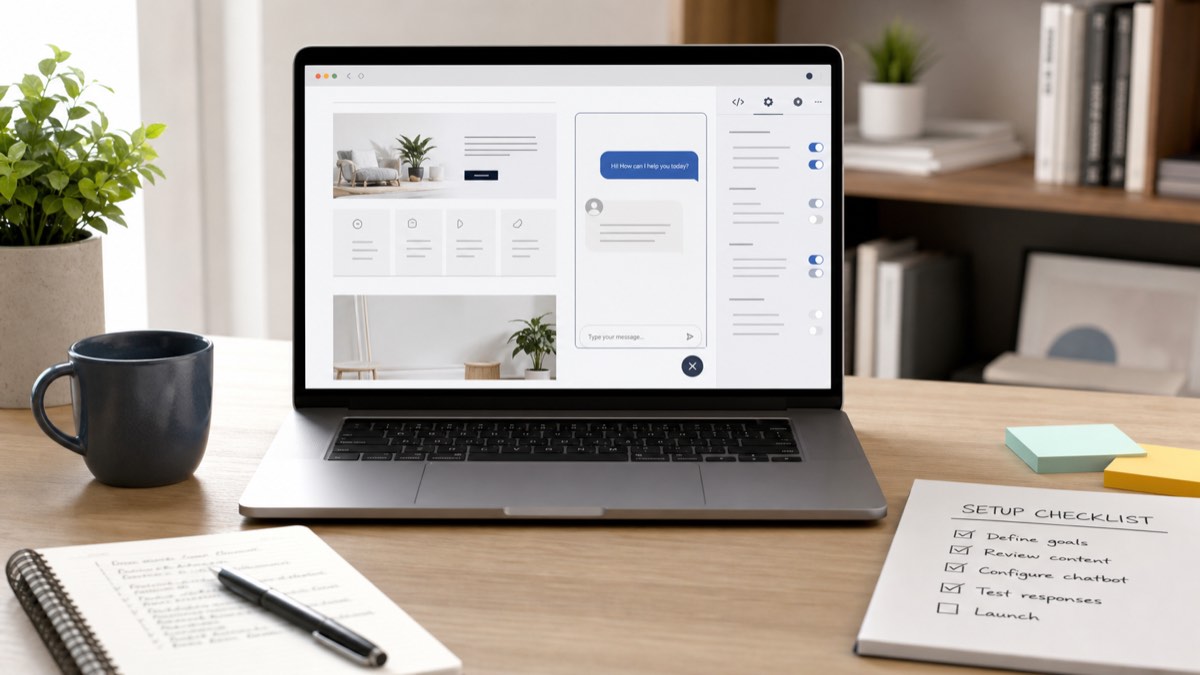
An AI website assistant for consultants changes this equation by answering initial questions and gathering useful qualifying context before the first call, without requiring the consultant to be present.
Why Consultants Lose Warm Leads—and Do Not Always Know It
The missed-lead problem in consulting is quieter than in most industries. A retailer knows when a cart is abandoned. A clinic knows when a call goes to voicemail. A consultant rarely knows that an interested prospect visited their website at 9 p.m., had a question, received no answer, and contacted someone else by morning.
High-intent visitors do not always browse at convenient times. They research between meetings, late at night, and on weekends. For services that require comparison and consideration, such as consulting, that browsing window is wide and unpredictable. When a website cannot respond during that window, interest may cool before the consultant becomes available.
The response window is shorter than many consultants realise
The odds of contacting a web lead were approximately 100 times greater when the first call was attempted within five minutes rather than 30 minutes. In a separate 2017 audit of 433 B2B companies, only 7% responded within five minutes.
Sources: Lead Response Report, citing the 2007 Lead Response Management Study; and Call Force Global's 2026 source summary, citing Drift's 2017 audit.
The second dimension of the problem is quality, not just timing. Even when consultants respond promptly, the first conversation often becomes a qualification call—spent discovering what the enquirer needs, whether they are a decision-maker, what their timeline is, and whether the project is a serious opportunity or early-stage exploration.
That is valuable consultant time applied to questions a well-configured assistant could have asked before the call.
For consulting firms, the problem scales. Several consultants may all be in billable client work while inbound enquiries sit in a shared inbox for hours. By the time someone follows up, the prospect may already be speaking to another provider.
How an AI Website Assistant Qualifies Leads Before You Pick Up the Phone
An AI website assistant trained on a consultant's approved content can support the pre-qualification journey—from the visitor's first question to a summarised, consented lead profile. Here is how that journey works in practice.
Stage 1: The Visitor Asks a Question and Gets a Useful Answer
The assistant responds immediately, using the consultant's approved content. That content can cover services, methodology, engagement models, sectors served, and typical project scope.
The visitor receives a specific answer while they are actively evaluating the consultant, rather than a holding message promising a later response.
This matters because unhelpful first responses create friction. A visitor who asks, “Have you worked with professional services firms before?” and receives, “Thanks for your enquiry; we will be in touch,” still does not have the information they need.
Stage 2: The Assistant Gathers Qualifying Context
Through a natural conversation, the assistant asks the questions that matter to the consultant. What kind of project is the visitor working on? What is their timeline? Are they evaluating multiple providers? What outcome do they want? Have they worked with a specialist consultant before?
The consultant configures these questions using their actual intake criteria. The assistant asks them one at a time, creating a guided exchange instead of presenting a long form all at once. This can reduce friction while still gathering the context needed for a useful follow-up.
Stage 3: The Lead Is Captured With Consent
Before contact details are stored for follow-up, the visitor is clearly asked for permission. The purpose is stated and the choice is genuine.
This consent-led approach means the resulting lead has actively chosen to continue the conversation. With the visitor's consent, the lead profile—including their needs, timeline, context, and contact details—can be delivered to the consultant through email, Slack, or a CRM integration.
The first call then starts with context instead of starting from scratch.
What the First Call Looks Like When the Lead Is Already Qualified
The difference is easiest to see directly.
WITHOUT an AI website assistant
A consultant receives a contact-form submission at 9 p.m. The message reads, “Hi, I’m interested in your services. Please get in touch.” The consultant calls the next morning. The opening part of the call is spent discovering what the enquirer needs, whether they have a budget, what their timeline is, and whether the project is a suitable fit. The consultant must gather the basics before either party can have a substantive conversation.
WITH an AI website assistant
The same enquirer visits at 9 p.m. The assistant answers questions about the consultant's methodology and typical engagement structure. It asks about the project, timeline, and decision stage. The enquirer shares their details and agrees to be contacted. The next morning, the consultant receives a lead profile containing the project type, timeline, decision stage, and what the prospect already knows about the service. The first call starts at step three, not step one.
This is what a well-configured AI lead generation chatbot does differently from a contact form. The form captures a name and a short message. The assistant captures context at the moment when the visitor is most engaged.
Where It Makes the Biggest Difference: Four Consulting Scenarios
Independent Consultants Billing Full Days
When most working hours are committed to client delivery, there is little time for qualification calls that do not progress. An AI website assistant handles the initial screening so the consultant's first conversation with a prospect begins with useful context and a clearer indication of fit.
Consulting Firms With Multiple Practice Areas
A firm covering strategy, operations, and digital transformation receives different enquiries for each practice area. Multiple assistants—one for each area and trained on the relevant content—can answer with the right context and route each enquiry appropriately.
Consultants Working Across Time Zones
A UK-based consultant with clients in the UAE, Singapore, or the US cannot personally maintain the same response time across every time zone. CYBOT can handle enquiries in any of its nine supported languages, using automatic language detection, while the consultant is unavailable.
Consultants Who Want Better Leads, Not Just More Leads
More enquiries are not always the goal. An assistant configured around the consultant's engagement criteria—such as project type, sector, timeline, and decision stage—can gather the information needed to prioritise promising prospects and respond helpfully to enquiries that are not a suitable fit.
See How CYBOT Qualifies Leads for Consultants
CYBOT is designed for service businesses that need every enquiry handled accurately and with consent, using content they have approved.
Explore CYBOT for ConsultantsWhy CYBOT Is Built for the Way Consultants Work
CYBOT was designed around the constraints of service businesses, including consultants who cannot be available to every visitor at every hour and who need their first conversation with a prospect to be worth having.
- Answers from your approved content: Services, methodology, sector experience, and engagement models remain the source for answers. The assistant is configured to stay within that content.
- Consent-based lead capture: Visitors are asked before their contact details are stored for follow-up. There are no pre-ticked boxes or hidden capture flows.
- Multiple assistants from one account: Consulting firms can run a separate assistant for each practice area, with independently approved content and qualification criteria.
- Automatic detection across nine languages: International enquiries can be handled in any of CYBOT's supported languages without separate website implementations.
- No conversation data used for model training: Visitor conversations are not used to train CYBOT's models or third-party foundation models.
For a deeper look at privacy-first design and why it matters for service businesses, read what an AI website assistant does differently.
Frequently Asked Questions
Can an AI website assistant qualify leads as well as a human?
It can handle initial qualification by asking configured questions, collecting answers, and capturing contact details with consent. It does not replace a consultant's judgement. Instead, it ensures that judgement is applied with better context.
What questions can the assistant ask to qualify a lead?
A consultant can configure questions about project type, timeline, budget range, decision stage, desired outcomes, and previous experience with consultants. The questions are asked conversationally rather than presented as a long static form.
What happens to lead information after it is captured?
With the visitor's consent, the lead and relevant conversation context can be delivered to the consultant through email, Slack, or a CRM integration. Visitor conversations are not used for model training.
Can a consulting firm run different assistants for different practice areas?
Yes. A firm can run multiple assistants from one CYBOT account, with separate approved content and qualification criteria for each practice area.
How long does it take to set up an AI website assistant?
The technical installation is quick, but total setup time depends on the readiness of the consultant's service content, qualification questions, routing rules, and testing. The widget is added using a supplied website snippet, so extensive development work is typically unnecessary.
Give prospective clients useful answers before the first call and give your team the context to make that call count. Explore CYBOT for consultants →